
Building Rider Core Strength for Better Balance in Saddle
Why a Warm-Up Matters More Than You Think
Nerves show up in the body long before you trot into the ring. Tense shoulders, short reins, a tight lower leg and, most tellingly, held breath. Horses are brilliant at reading all of it, and a tense rider quickly becomes a tense horse. A proper warm-up is not just about loosening muscles — it gives you a job to do, and a job is the fastest cure for a case of the jitters.
The aim is simple: find a steady rhythm, soften your horse's back and neck, and give yourself a handful of small successes before you ask for anything bigger. You should finish your warm-up feeling that the horse is with you, not that you have merely survived twenty minutes.
Start on the Ground, Not in the Saddle
Give yourself five minutes before you mount. Walk your horse out in-hand, ask for a halt, ask for a step back, then walk a small circle on each rein. It is unhurried, useful work and it settles both of you. While you do it, breathe deliberately: in through the nose for a count of four, out through the mouth for a count of six. Do this ten times. It sounds trivial, but it lowers your heart rate and stops you gripping the reins the moment you swing into the saddle.
Check your girth, run your stirrups down, and mount from a block rather than the ground — a struggling mount sets a nervous tone for everything that follows.
The First Ten Minutes: Rhythm Above All
Forget outline and outline-related guilt. Your only goal for the first ten minutes is an even, swinging rhythm. Work around the outside track in walk on a long rein, letting your horse stretch down and forward. Then:
- Ride two large 20-metre circles in working trot, changing rein across the diagonal between them.
- Ride a three-loop serpentine in trot, keeping each loop the same size and the rhythm unaltered.
- Make a transition every six to eight strides — walk to trot, trot to walk. Keep them calm and forward.
Count out loud as you ride: one, two, three, four in time with the footfalls. It gives your brain something rhythmic to hold on to and stops you over-thinking the jumps ahead. If your horse rushes, slow the counting rather than pulling on the reins.
Three Exercises That Build Confidence
These work best in the middle third of your warm-up, once the horse is genuinely forward.
- Five forward, five back. In rising trot, ask for five noticeably longer strides, then five shorter, more collected ones. Repeat down each long side. You are proving to yourself that you can control the pace with your body rather than your hands.
- Serpentine with a change of bend. Three loops in trot, then repeat in canter on the middle loop only. Straightness and suppleness improve, and the change of direction keeps a spooky horse listening.
- Leg-yield on the long side. From the three-quarter line, push your horse's shoulders slightly in while the body stays straight. It is quietly gymnastic, it improves the outside rein, and it gives you something technical to focus on instead of nerves.
Introducing Poles and Small Fences
Poles come before fences, every time. Set four trot poles on a straight line about 1.2 to 1.3 metres apart and ride through them in a rising trot, looking up and counting the rhythm. Then set three canter poles at roughly 2.8 to 3 metres apart and ride through in a light seat. If the horse hurries, come back to trot, re-establish the rhythm and try again.
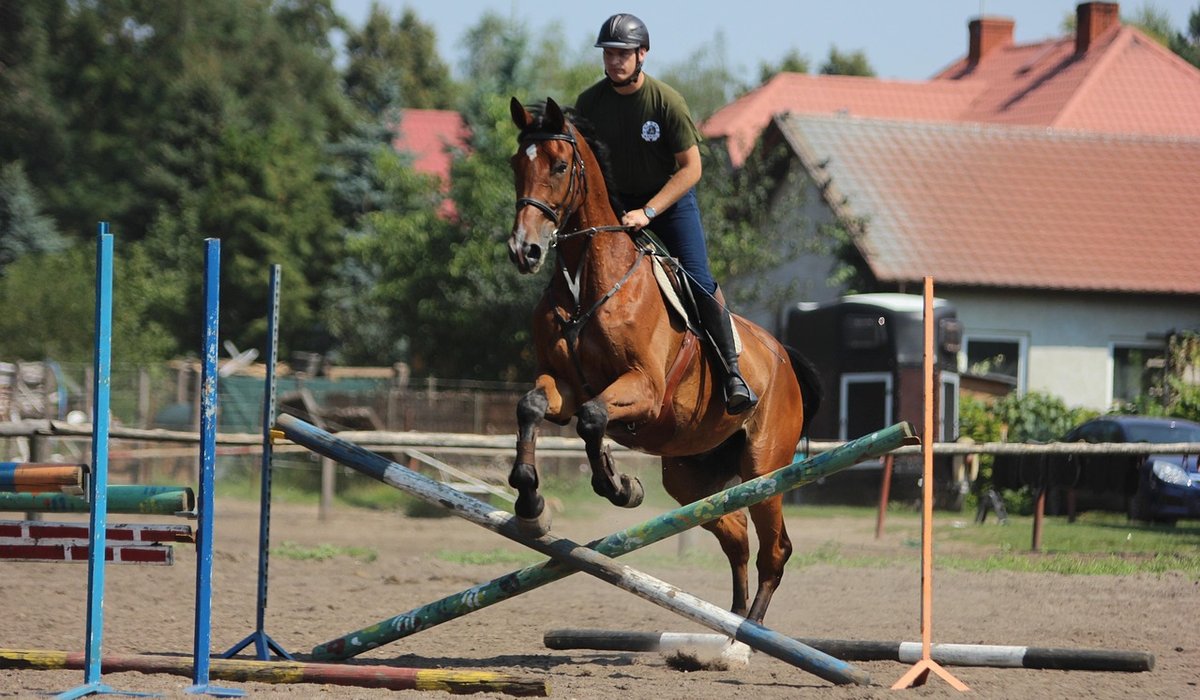
For jumping, start with a single cross-pole at 50 to 60 centimetres with a ground line pole in front. Approach in trot, count down out loud — three, two, one, jump — and let the fence come to you. Ride away in a straight line for six strides before you turn or slow down. Three or four good jumps is plenty. A short, sweet session leaves your horse wanting more and your confidence intact.
A Warm-Up Routine You Can Repeat Every Time
Knowing the plan in advance removes the worst of the nerves, because there is nothing left to decide.
- Five minutes: in-hand walk, halt and rein back.
- Ten minutes: walk on a long rein, then trot circles and transitions.
- Five minutes: canter work, including one of the confidence exercises above.
- Five minutes: trot and canter poles, then a handful of small fences.
- Two minutes: walk on a long rein, pat your horse, and breathe.
Finish on something your horse does well, even if it is only a quiet halt in the middle of the arena. Then get off, loosen the girth, and take a moment to notice what went right rather than cataloguing what did not. Confidence is built in these small, unglamorous repetitions — and a rider who knows their warm-up inside out walks into the ring with far less to fear.
LEAVE A COMMENT